Exploring the Human Experience Through the Eyes of Gustav Klimt
The story of a man who was ironic and complicated, as his art reflects. Whilst the Golden Phase appears jubilant, the emotion I keep returning to is sadness, and it does not come from his subjects, but the vulnerability he creates through them.
It seems rather fitting to be writing about Gustav Klimt following the announcement that his Portrait of Gertrude Leow (1902) is to be put forward for auction this June. Given the sale of the Portrait of Elisabeth Lederer (1914-1916) for $236.4 million in November of 2025, it is hardly surprising that another of Klimt's works is capturing the attention of collectors worldwide. This is not strictly confined to those within a Sotheby's or Christie's Auction House either, with many, include myself, amateur admirers or enthusiasts engaging deeply with the story of a man who was ironic and complicated, as his art reflects.
Born in Baumgarten, Austria in 1862, and a member of the Secessionist Movement, Klimt existed in a space that redefined the zeitgeist of 19th Century Vienna. The traditional city was experiencing an age of rebellion, propped up by progressive artists like Klimt himself, or Egon Schiele and Max Kurzweil. After diverting from his early style of Neo-Renaissance and Neo-Baroque, and suffering the loss of his father and brother, Klimt dived head first into producing work that's language was now overtly sexual, ornate and symbolic, a stark contrast to the pompous, reserved art that dominated Viennese culture.
Klimt's 1901 'Beethoven Frieze,' that remains in the Secession Building in Vienna was a piece which marked this transition into the highly decorative style that would come to define his artistic approach. Acting as an almost physical translation of Beethoven's 9th Symphony (1824), it depicts a knight being weakened by the vices of mankind, surrounded by demonic creatures. It reads as a struggle for “compassion and ambition”, where he is eventually reunited with his lover. This is central to how we understand Klimt, especially when considering his promiscuous personal life. He notably avoided marriage, but kept multiple intimate relationships with women, allegedly fathering more than fourteen children, all while living with his mother and two sisters. Is this why demonic figures emerge in this frieze, because it represents his tumultuous personal life and internal feelings? Whilst we may never truly know this, this frieze is incredibly confronting. It is also the first major work that kickstarted his 'Golden Phase', wherein gold leaf was to be used as an important symbolic addition to his paintings.
As perhaps my most favourite feature of the many paintings within the Golden Period, Klimt's focus on female sensuality sparked criticism and shock within Viennese society, where conservative dress and attitudes remained the norm. His paintings directly contradicted this which at the time, stigmatised the artist as 'pornographic'. To the modern viewer, this reflects a kind of bourgeois perspective often attributed to the early 20th century, but it hardly misrepresents Klimt. His common habit of remaining nude under his painting smock reflects the kind of eroticism portrayed in his paintings, albeit in a more restrictive way.
Klimt explored the female form, creating women that almost dance within the patterns formed around and within them, leaving their bare skin as an almost deliberate consequence of this. The sensuality that is created by this deliberate artistic choice of Klimt's, reads to me a story of vulnerability and the human form in its purest sense, and his 1910 painting of The Family directly communicates this. Although separated by gender and age, his depiction of the family as almost one breath, is engrossed by intricate patterning that establishes a chaotic aspect to the painting. Simultaneously, the warm embrace of a child by their mother and father counteracts this chaos, and brings a level of calm and simplicity amongst a scene that otherwise complicates your emotional response when viewing it. It shows union in a world that is euphoric and bleak, all at once.
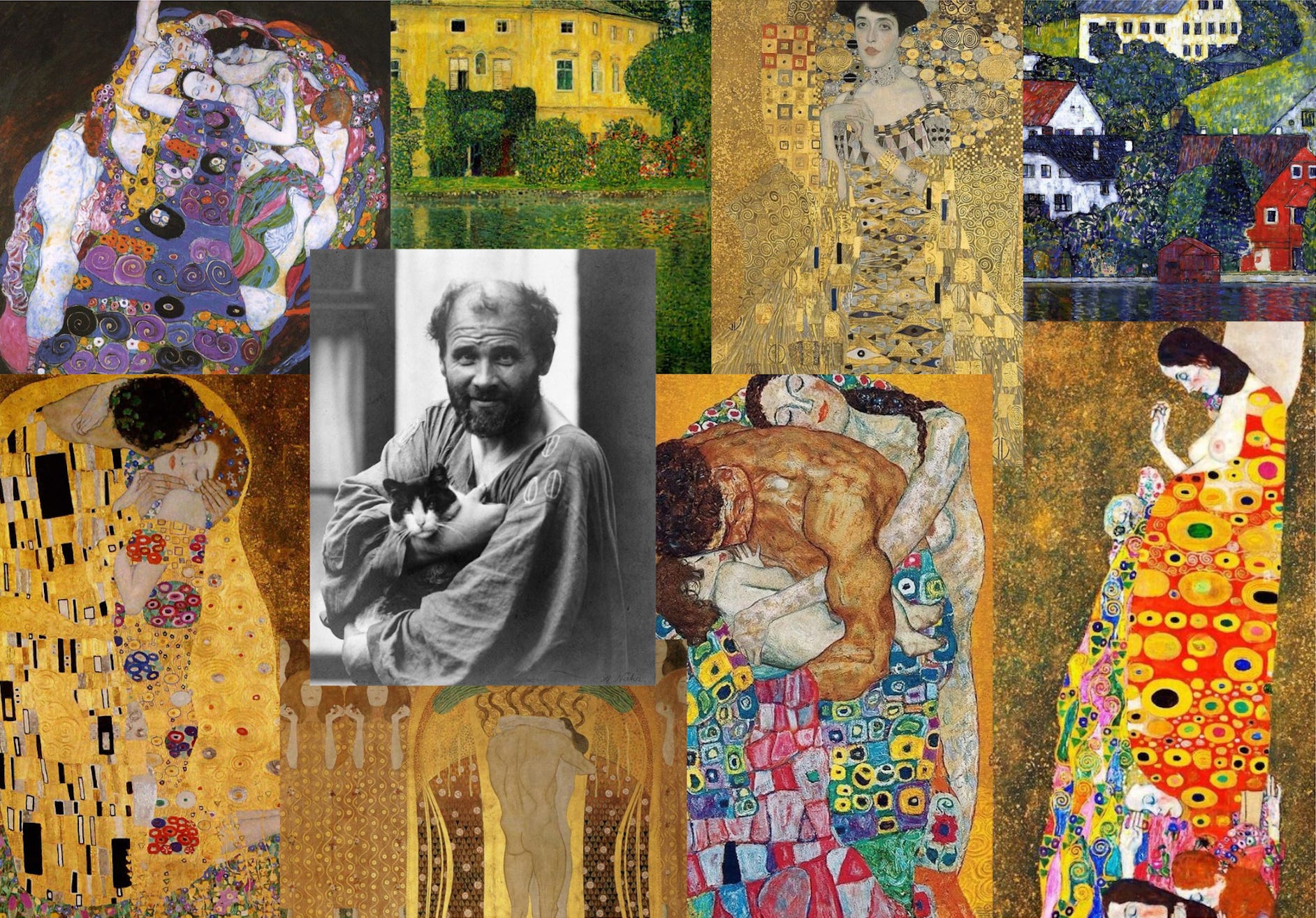
The sadness does not come from the subjects themselves, but the vulnerability that Klimt creates through them.
When I look back at notes I made during my research of Klimt, I can't help but notice the word 'SAD?' sitting at the corner of the page. A rather confusing emotion that I experience is sadness when viewing many of Klimt's paintings. At first glance, they do not appear to purposefully ignite this emotion from their viewers. They are surrounded by harsh but jubilant patterns reminiscent of Japanese textiles, Byzantine art, and Ravenna church mosaics, so joy must be the only emotion to feel. However, when I evaluated why I thought this way, I came to the conclusion that the sadness does not come from the subjects themselves, but the vulnerability that Klimt creates through them. It highlights the fleeting moments of human life, the moments we often take for granted in search of extravegant experiences.
Equally, it would be reductionist to not mention his most famous work, 'The Kiss', which I contend perfectly emphasises the emotional versatility and complications of love and humanity. A simple glance at this painting brings forth relatability to the simplicity and passions of love, but it is more complex than this. Situated on a bed of flowers, a woman's delicate body is engulfed by the harsh rectangular lines of a man that serves her, as an accessory would, with a kiss to which she accepts, but does not yield to. At the same time, they are almost wrapped up in a 'shroud' of gold (to which he applied 8 different types) used as a symbolic manifestation of desire and beauty, working against the bare feet of the female, gripping onto a cliffs edge as if to communicate temporary euphoria. Through these choices, The Kiss transcends time and history, and creates a scene that many of us can relate to, inspired by our own contexts and human experiences.
There are many emotions and ways to interpret Klimt's work, too many to include within this post. However, the lessons we gather as humans from them remain, and are important to include, as I conclude. In a culture of constant stimulation made possible through parasocial relationships and instant access to strangers' lavish experiences, we tend to forget the lessons that sensitivity teaches us. The act of sharing this with others, as Klimt did through simple depictions of embrace or affections, shows that something as simple as this can conquer complexity. This is something that I hope to keep with me through my personal relationships in the present, and the future.
Leave a thought
…There are many ways to interpret a piece of writing, and I would like to hear yours. Whatever you leave here will sit under this essay only.